
Designing for Fabrication Construction and Real World Delivery
A design can look resolved on screen and still fail the moment it reaches a workshop, a truck, or a muddy site. The gap is rarely caused by a lack of creativity. More often, it comes from treating fabrication and construction as tasks that happen after design, rather than conditions that shape the design from the start.
Designing with delivery in mind means asking practical questions early. Can it be made with available tools? Can it be transported safely? Can it be lifted, aligned, fixed, inspected, repaired, and replaced? These questions do not limit good design. They make it stronger.

Start with how the thing will be made
Fabrication is not a neutral step. It affects cost, quality, lead time, tolerance, finish, and waste. A design that ignores the making process often creates hidden problems for the teams expected to deliver it.
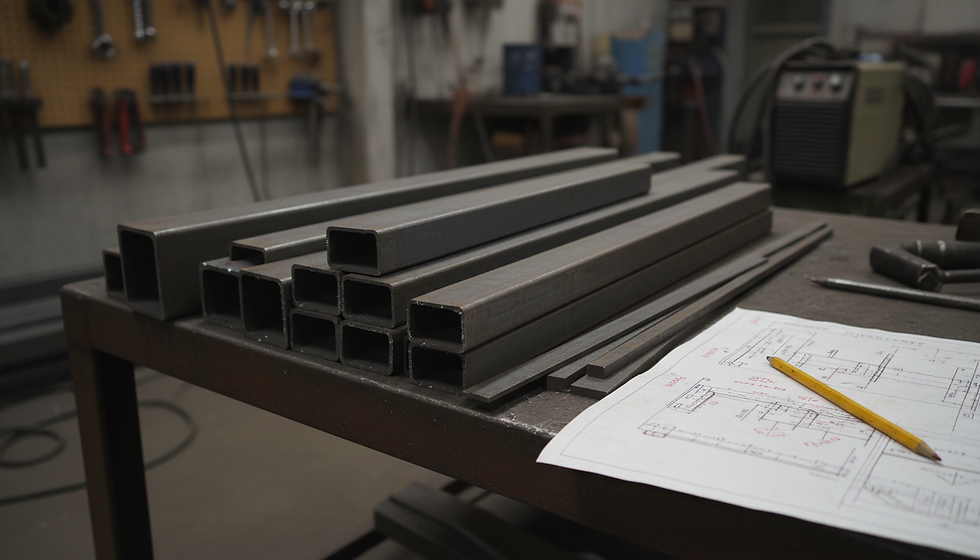
A simple example is steel plate. A drawing might show a clean custom profile, but the workshop needs to cut, drill, weld, treat, and handle that plate. Small design decisions can add extra set-ups, special jigs, more handling, or awkward welds. None of that may be visible in the finished object, but it affects programme and price.
The same applies to joinery, precast concrete, façade panels, balustrades, signage, brackets, and modular components. Each trade has preferred stock sizes, machine limits, fixing methods, and finish constraints.
Early design work should include:
Material availability
Common sizes and grades are usually easier to source, replace, and price.
Machine and tool limits
Cutting beds, press brakes, CNC routers, welding access, and mould sizes all have real boundaries.
Repeatable details
Repetition reduces errors and makes quality easier to control.
Finish protection
A delicate finish may survive the drawing package but not the delivery truck.
Designing for fabrication, construction and real-world delivery is not about making everything standard. It is about knowing when custom work is worth it, and when it adds risk without adding value.
Draw the construction sequence before the details are locked
A component is never installed in isolation. It arrives in a sequence. That sequence includes access, temporary works, lifting, storage, weather, other trades, inspections, and sign-off.
If the design can only be understood as a finished object, something is missing. Delivery needs a step-by-step view.
Ask questions such as:
What must be built first?
What needs to remain accessible until later?
What cannot be installed once adjacent work is complete?
How will tolerances build up across trades?
Where can people safely stand, lift, and fix the work?
What happens if the site is wet, cramped, or behind programme?
These questions are especially important on Australian projects where site conditions can vary widely. Heat, coastal exposure, remote delivery, long transport distances, and tight urban access can all influence design decisions.
Design for tolerances, not perfect conditions
Drawings are precise. Built work is not. Materials move, slabs vary, steel deflects, concrete cures, timber swells, and existing buildings rarely match old documentation.
Good delivery-focused design gives the site enough room to absorb variation without losing the design intent.
That does not mean accepting poor workmanship. It means designing intelligent adjustment into the system. Slotted holes, packers, cover trims, adjustable brackets, shadow gaps, movement joints, and staged fixing all help real projects land cleanly.
The key is to decide which dimensions matter most.
Some dimensions are critical because they affect safety, waterproofing, accessibility, structure, or alignment with other systems. Others can tolerate small variation. If every dimension is treated as equally critical, the construction team receives no useful guidance.
A practical drawing set should show:
Critical hold points
Set-out references
Acceptable adjustment zones
Interface requirements
Fixing access
Inspection points
Movement and clearance allowances
The best details do more than describe the finished result. They explain how the work survives contact with real conditions.
Think about transport, handling, and access
A design that can be fabricated may still be difficult to deliver. Size, weight, lifting points, packaging, route restrictions, site storage, and crane access all matter.
A panel might fit the building but not the truck. A stair might be strong enough in use but awkward to lift without twisting. A façade element might be beautifully detailed but too fragile to stack. A long component might need a road permit, special escort, or split delivery. These issues can reshape the project late if no one tests them early.
Can it be safely made, checked, finished, labelled, and packed?
Can it fit legal vehicle limits and survive vibration, weather, and restraint loads?
Can it be unloaded, stored, lifted, rotated, positioned, and fixed with available access?
Can it be maintained, removed, or replaced without destructive work?
Where possible, break large elements into logical modules. Design joints where they are easy to align, seal, inspect, and conceal. Avoid forcing site crews to complete high-risk precision work in poor conditions when it could have been resolved in the workshop.

Bring fabricators and builders in before the design hardens
Late input often becomes bad news. Early input becomes better design.
Fabricators and builders can spot issues that are invisible in a clean model. They know which details take too long to make, which fixings are hard to access, which tolerances usually cause disputes, and which finishes are prone to damage during installation.
This input is most useful before documentation is complete. At concept or design development stage, small changes are still cheap. A bracket can move. A module can shrink. A joint can shift to a better location. A finish can change from fragile to practical. Once procurement begins, those same changes become delays, variations, and rework.
The strongest process creates a loop between design intent and delivery knowledge:
Define the design intent clearly.
Test the likely fabrication method.
Review the install sequence.
Check transport and site access.
Adjust the design.
Document the decisions clearly.
This loop should not dilute the design. It should protect the parts of the design that matter most.
Real-world delivery makes design more durable
Design quality does not end at the drawing package. It is tested in procurement, fabrication, transport, storage, installation, inspection, maintenance, and use.
When those stages are considered early, the design becomes easier to price, easier to build, and easier to defend. Details become cleaner because they respond to real constraints. Materials perform better because they were chosen with handling and exposure in mind. Builders make fewer assumptions because the documentation explains the intent.
The best built outcomes come from a simple discipline: design the object, then design its journey into place. If both are resolved, the result has a far better chance of matching the promise of the original idea.


Comments