
Why Fabricators Prefer Simple Engineering Solutions
A neat CAD model is great, but a part still has to be cut, drilled, welded, lifted, checked and fitted. That’s where simple engineering earns respect on the workshop floor.
Fabricators don’t value simplicity because they dislike clever design. They value it because the best solutions are usually the ones that can be built cleanly, safely and repeatedly.
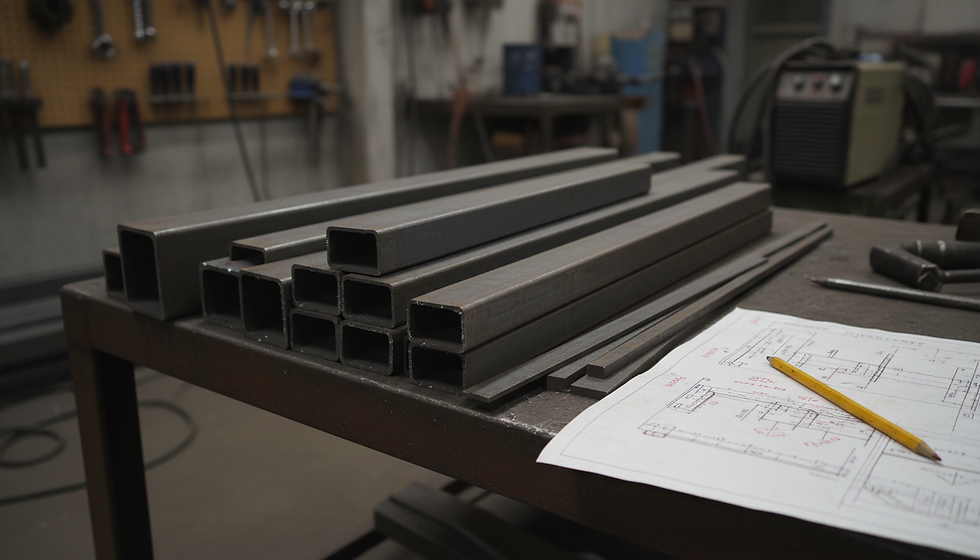
Simple designs cost less to build
Every extra bend, hole, weld, tolerance and custom plate adds time. It may look small on a drawing, but it can mean another setup, another jig, another inspection point or another chance to scrap a part.
A simple design often uses:
Standard steel sections
Common plate thicknesses
Straight cuts where possible
Repeated details
Easy-to-access welds and bolts
Clear tolerances that match the job
That’s the practical value of simplicity in design, including cost-effectiveness, ease of manufacturing, and reduced error rates.
It also helps with procurement. A design based on readily available RHS, UC, UB, flat bar or standard fasteners is easier to quote and easier to schedule. Less waiting, less chasing odd materials, fewer surprises.
Simple parts are easier to manufacture well
Fabrication rewards repeatability. If ten brackets are identical, the team can set up once and make them accurately. If every bracket is slightly different, the job slows down and the error risk climbs.
Simple doesn’t mean basic. It means the design respects the way things are made.
For example, a bracket with generous access for welding is better than one that forces a welder into a tight corner. A bolted connection with enough spanner clearance is better than one that looks tidy on screen but can’t be tightened on site. A frame with sensible member alignment is easier to jig, square and inspect.
This is one big reason why fabricators value simple engineering solutions. A clear design lets skilled trades do their best work without fighting the detail.
Simple engineering has proved itself in the real world
Some of the most successful mechanical and structural ideas are built around plain, repeatable principles.
The Bailey bridge is a classic example. Developed during the Second World War, it used prefabricated steel truss panels that could be assembled quickly without heavy equipment in many situations. Its strength came from simple geometry, repeatable parts and practical connections.
Shipping containers are another good example. Their strength relies on a simple steel frame, corner posts and standardised corner castings. That simple structural logic made them easy to stack, lift and move across ships, trucks and rail.
Portal frame sheds show the same thinking in everyday Australian construction. Repeated frames, standard purlins and straightforward bolted connections make them fast to fabricate and erect. They’re not fancy, but they work, and that’s the point.

Simple details improve collaboration
Good collaboration between engineers and fabricators starts with shared reality.
Engineers understand loads, code requirements and design intent. Fabricators understand access, distortion, sequencing, welding, handling and site fit-up. When the design is simple, both sides can talk clearly about what matters.
A fabricator can say, “That plate will pull during welding,” or “Move this hole and we can drill it in one setup.” An engineer can respond without redesigning the whole job.
That back-and-forth works best when details aren’t overcomplicated. Simple designs make room for practical fixes before they become expensive problems.
The best simple solution still does the hard work
Simple engineering isn’t lazy engineering. It takes judgement to remove clutter without removing strength, safety or function.
The goal is a design that carries the load, fits the space, meets the standard and can be built without drama.
That’s why fabricators tend to respect simple solutions. They reduce cost, cut mistakes, speed up manufacturing and make collaboration easier. Most of all, they turn good ideas into real steel, bolted, welded and working.


Comments